HIC #215784
Registered Massachusetts
home improvement
contractor

Disney Best Services · HIC #215784
Disney Best Services installs tile across Cape Cod: shower and bathroom tile, kitchen backsplashes, and floor tile in homes from Provincetown down to Plymouth.
Tile is where a Cape Cod house tests the work hardest. Waterproofing behind the tile matters more than the tile itself, and the freeze-thaw swing from November into March finds any grout joint or substrate that was rushed.
HIC #215784
Registered Massachusetts
home improvement
contractor
$1M General Liability
Workers’ compensation
coverage
Free Estimates
On-site review before
a written quote
One Year, Written
Workmanship coverage
provided before
work begins
Our Work

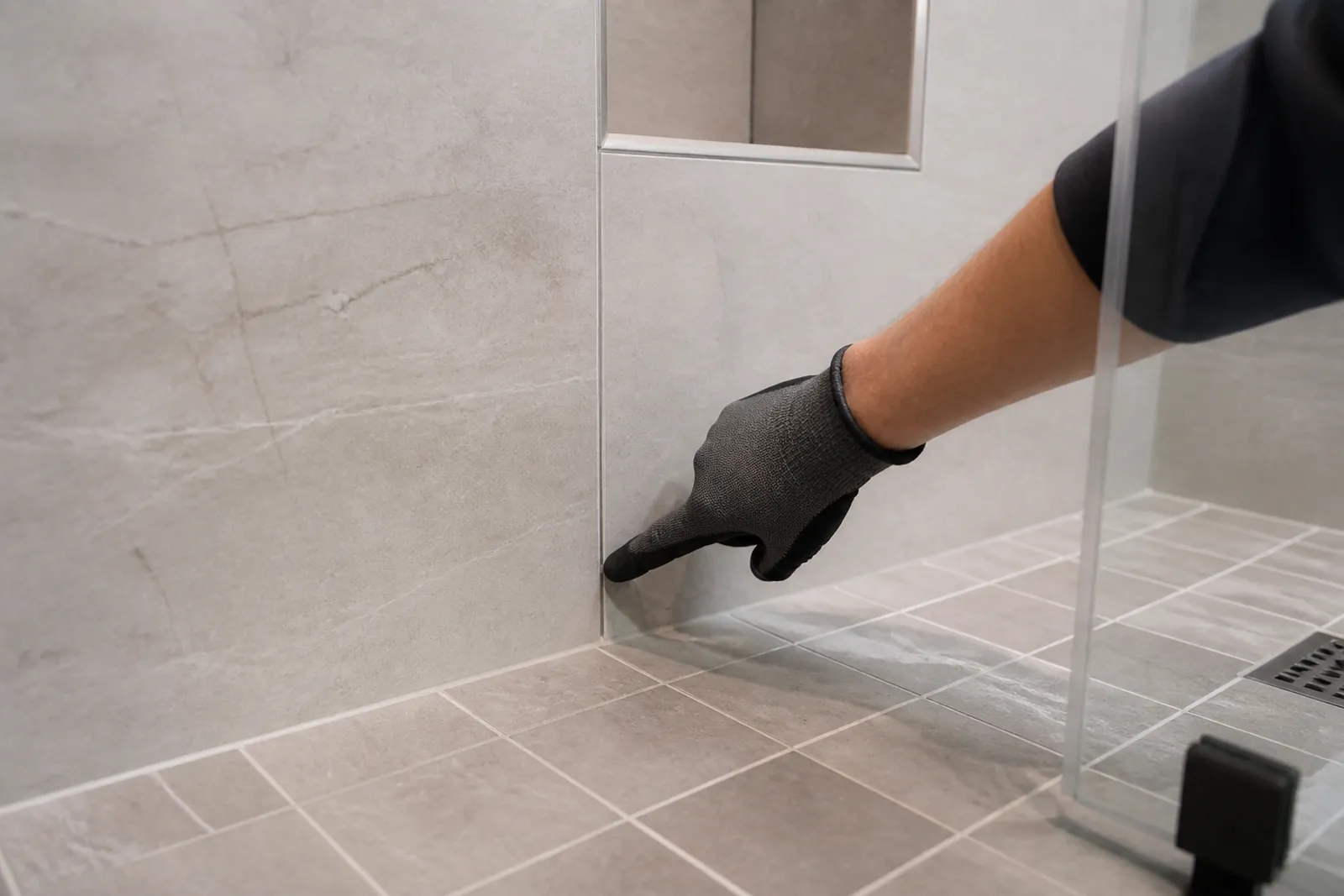
Shower tile is a waterproofing job with a tiled surface on top. We build the substrate and the waterproofing layer first, because that is what decides whether the installation lasts or fails quietly behind the wall.

Backsplash work has to meet cabinetry and counters that are rarely perfectly square in an older house. The cuts at the edges and around outlets are what separate a clean job from an obvious one.
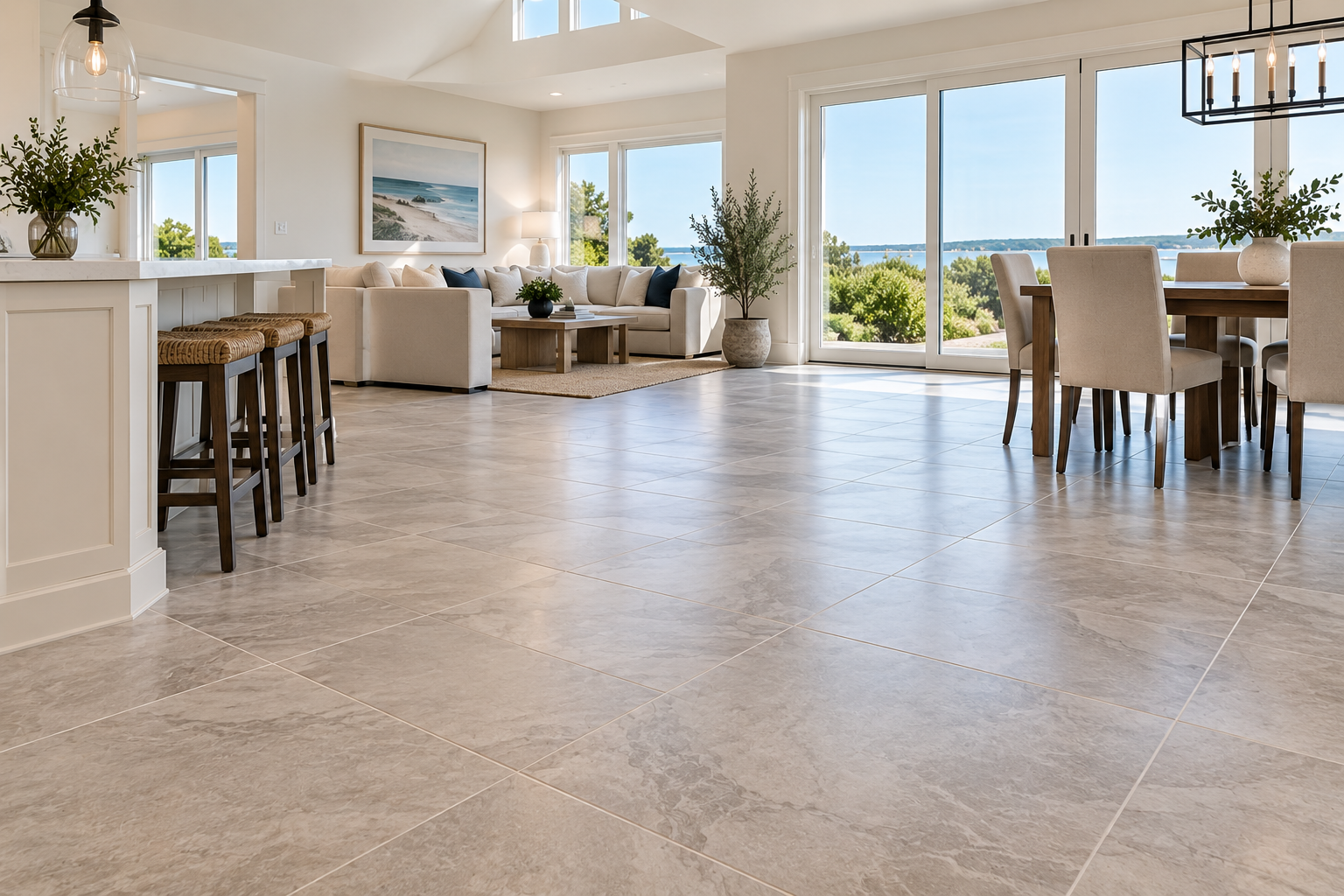
Floor tile needs a substrate that does not move. On older Cape houses that often means addressing deflection in the subfloor before any tile is set, rather than discovering the problem through cracked grout a year later.
Shower waterproofing systems
Tile and grout are not waterproof. The membrane behind the tile is what stops water, and ANSI A118.10 is the standard that load-bearing bonded waterproof membranes are tested against. Four systems are in common use. Choose one before tile goes up, because changing it afterward means removing the tile.
| Waterproofing system | How water is stopped | Where it fails | Pick this when |
|---|---|---|---|
| Bonded sheet membrane over cement backer board | A manufactured sheet is bonded to the board with thinset mortar, with the maker's seam tape and preformed inside and outside corners | Seams, inside corners, and the connection at the drain flange | You want one known membrane thickness everywhere and a continuous surface you can look at before tile covers it |
| Liquid-applied membrane | Rolled or troweled on in coats until the maker's wet film thickness is reached, with reinforcing fabric at every change of plane | Coats applied too thin, because the film itself is the only barrier and thickness is hard to judge by eye | The shower has niches, a bench, curves or tight geometry that sheet goods fight |
| Foam panel system with a matched tray and bonded drain | Waterproof boards, a pre-sloped tray and a bonded drain from one maker, joined with that maker's sealant and seam tape | Parts mixed between makers, and fasteners placed where the instructions do not allow them | You want the pan slope and the drain connection built into the product rather than formed by hand |
| Mortar bed with a sheet pan liner and clamping drain | A sheet liner laid over a sloped pre-slope and clamped into a two-part drain, turned up the curb with corners folded rather than cut | A missing pre-slope, a cut corner, or any fastener driven through the liner below the top of the curb | You are matching an existing mortar bed, or building a pan too large or too odd in shape for a tray |
Each system is tested as a kit. Parts from two different makers have not been tested together.
Tile outdoors and tile in unheated space fails because of what the tile body absorbs, not because of cold by itself. Water sitting inside a porous tile expands when it freezes. The expansion breaks the tile from the inside out. Frost-resistant tile with very low absorption survives the cycle. Porous tile does not.
ANSI A137.1 sorts ceramic tile by water absorption. Impervious tile absorbs 0.5 percent water or less by weight. Vitreous, semi-vitreous and non-vitreous tile absorb progressively more. Porcelain sits in the impervious group. The less water a tile body can hold, the less there is inside the tile to freeze and push the tile apart. ASTM C1026 is the freeze-thaw cycling test used on ceramic tile.
The tile is only one layer of an exterior or unheated assembly. The mortar bed, the membrane and the setting mortar all hold water too, and all of them go through the same freeze cycle. Outdoor steps, patios, garages, three-season porches and a basement left cold all run through freezing and thawing repeatedly in a single winter, not once. So an exterior tile assembly has to be built with exterior-rated mortar and membrane, and it has to let water drain out rather than sit under the tile.
Tile set over an existing sound substrate generally does not require a permit on its own. A permit becomes relevant once the work touches plumbing, structure or waterproofing in a way the building code treats as a change, which is common in a shower rebuild.
We tell you which side of that line your project sits on before work starts, and we file what is needed.
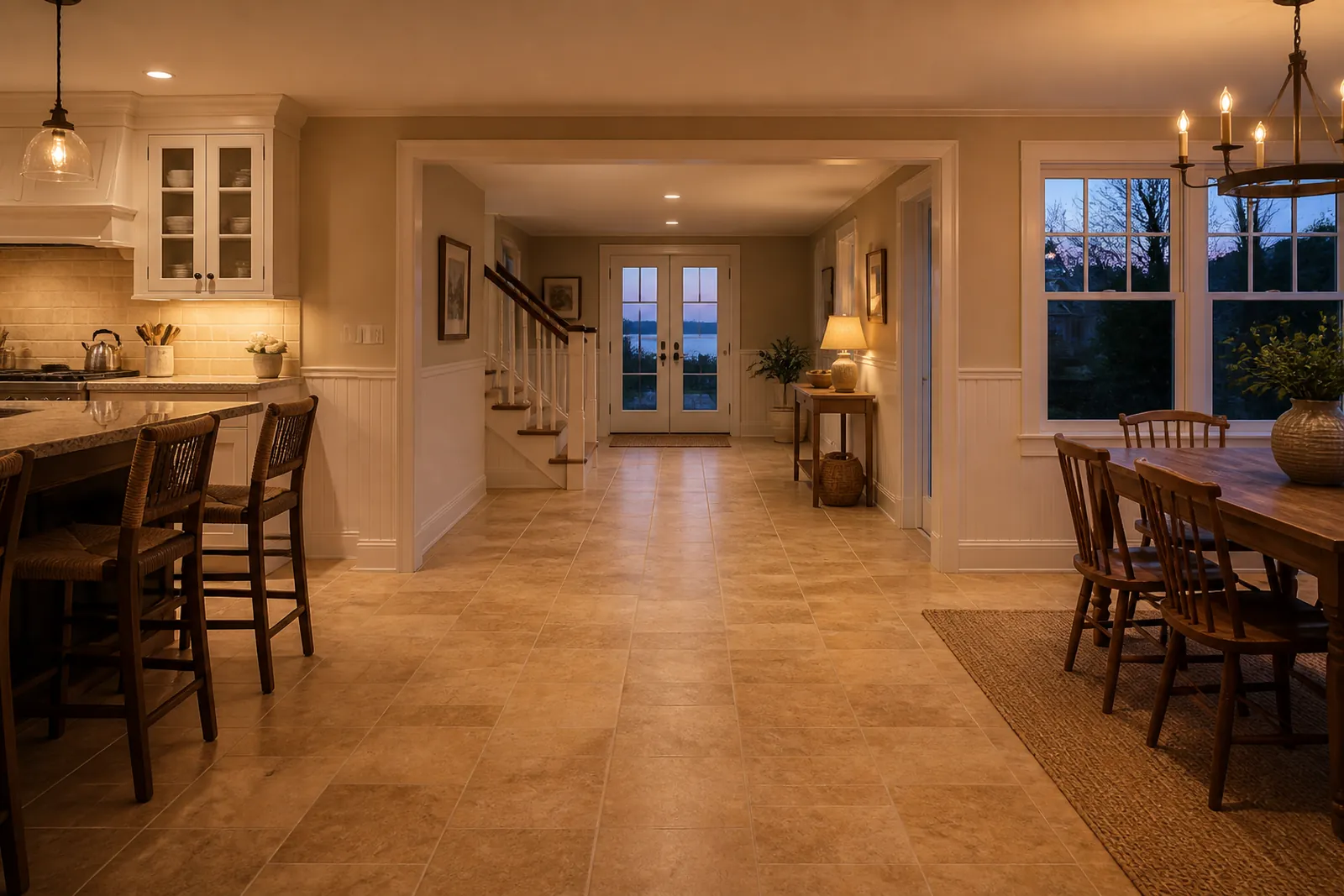
Cost follows the area being tiled, the format and material, how much preparation the substrate needs, and the complexity of the cuts. Large format and mosaic sit at opposite ends of the labour range for the same square footage.
We give a firm written quote after seeing the space. The estimate visit is free.
Before tile covers it
A flood test plugs the shower drain, fills the finished pan with water to just below the top of the curb, marks the water line, and leaves the water standing for 24 hours. The mark either holds or it drops. A homeowner can read that result without any trade knowledge.
The flood test is one of the few steps on a tile job that produces a plain result anyone can read. The water sits at a pencil mark on the wall or it falls below the mark. Nobody outside the job is going to ask whether the test happened. Once tile covers the membrane, the test can no longer be run at all.
Ask for the flood test by name on the written scope, with how long the water stands and who looks at the mark. Rankine Disney is on every active job site every working day, so there is someone on site who can walk you to the mark and show you the water line.
Waterproofing becomes invisible the moment tile covers it. The inside corners, the drain connection, the top of the curb, the bench, and the height the membrane reaches up the wall are all readable in a photograph and unreadable one day later. A leak found two winters from now cannot be traced back to any of those details without opening the shower.
Walk in before tiling starts. Photograph each inside corner, the drain, the curb, the bench and the wall height. Ask which waterproofing system is being installed and keep the maker's name filed with the photographs, so the shower has a record of what is behind the tile.

How tile work fails
Tile rarely fails because of the tile. Tile fails at the layers underneath and at the joints around the edges. Four failure modes are the ones that get torn out and redone: thin mortar coverage, missing movement joints, a floor that flexes too much, and waterproofing that stops short of where water goes.
Why it happensMortar coverage is the actual contact between the back of the tile and the mortar bed. Where there is no mortar, the tile spans an air pocket. A point load over that pocket has nothing supporting it, and the tile breaks. ANSI A108.5 calls for 80 percent mortar coverage in dry interior areas and 95 percent in wet areas and on exteriors, with full support at the corners of each tile.
What prevents itCoverage is decided at the moment each tile is set. Back-buttering, a trowel notch matched to the size of the tile, and lifting a set tile early in the job to read the mortar transfer are what control coverage. Once the mortar cures, coverage can no longer be changed or inspected without breaking tile.
Why it happensThe tile field and the slab or subfloor beneath move at different rates as temperature and moisture change. With no gap to absorb that movement, the tile field goes into compression and the weakest point gives way. TCNA EJ171 is the industry guidance on where movement joints belong, including at the perimeter of the field and at every change of plane.
What prevents itMovement joints are a layout decision made before the first tile is set. The joint has to be planned into the tile pattern, carried down through the mortar so it is a real break in the field, and then filled with flexible sealant rather than grout.
Why it happensDeflection is how far a floor bends under load between its supports. Industry guidance holds ceramic tile over a wood-framed floor to a deflection limit of L/360, and natural stone to a tighter limit than that. A floor that bends more than its limit works the bond loose and opens the grout, even when the tile itself was set correctly.
What prevents itDeflection is addressed before any tile is ordered, by measuring joist size and span and either adding structure or changing the assembly. An uncoupling membrane or a crack isolation membrane under the tile, covered by ANSI A118.12, handles in-plane cracking in a substrate but does not stiffen a floor.
Why it happensWater moves through grout joints by design, so grout is never the barrier. The membrane behind the tile collects that water and carries it to the drain. Where the membrane stops short at the top of the curb, dies out at a bench, is cut instead of folded at a corner, or is punctured by a fastener, water leaves the assembly and enters framing.
What prevents itA shower leak is prevented at the waterproofing stage, before a single tile is set, and it is confirmed by a flood test while the membrane is still open and visible. After tile goes on, the only way to check the membrane is to remove tile.
Disney Best Services carries a one-year written workmanship warranty, and cracked tile sits outside it, along with damage from floors or the house shifting and settling, and material or manufacturer defects. The reason is mechanical. Tile is rigid. A floor that deflects past its limit, or a slab that moves across a joint, pushes that movement into the tile field until the tile breaks. Movement joints relieve part of it. No joint stops a structure from moving. Cracked tile is a report on the structure, not on the mortar bond.
Frequently Asked Questions
Tiling over existing tile works only when the old tile is fully bonded, flat, and the added height still clears the door swing and the toilet flange. Any tile that sounds hollow has to come out first. A glazed surface also needs preparation, because setting mortar grips a sealed glaze poorly.
That corner is a change of plane, and grout is rigid, so grout breaks when the two planes move independently. Changes of plane take flexible sealant instead. TCNA EJ171 treats inside corners as movement joints. Regrouting the corner cracks again; cutting the grout out and running sealant holds.
Porcelain absorbs 0.5 percent water or less by weight, which is the impervious class under ANSI A137.1. In a mudroom taking snow, road salt and wet boots, low water absorption matters more than how the tile looks. A porous tile in the same spot holds water inside the tile body.
Exterior and unheated tile work needs frost-resistant tile with very low water absorption, exterior-rated setting mortar and membrane, and a drainage path so water leaves the assembly instead of sitting under the tile. ASTM C1026 is the freeze-thaw cycling test for ceramic tile. Interior-rated tile set outside on Cape Cod spalls.
Grouting the same day traps water in the mortar bed, which can discolor grout and weaken the bond. Setting mortars carry a published cure time before grouting on the product data sheet, and that time stretches in a cold or unheated room. Early grout in a shower also pushes back the flood test.
An intermittent shower leak points at the waterproofing rather than the tile face. Water needs volume and standing time to find a gap, so a short shower may not leak while a long one does. The usual sources are the drain connection, the top of the curb, and inside corners.
A long, stiff tile cannot follow a dip in the floor, so one edge lifts and you feel the lippage with a bare foot. Small tile spreads the same dip across many grout joints and hides it. Large tile starts with flattening the substrate, then back-buttering and a trowel notch matched to the tile.
Disney Best Services · East Harwich
If you are still working out the scope, that is the right moment to get in touch. We look at the space, assess what is there, and set out what the tile work involves before you commit to anything.
Disney Best Services is a Registered Massachusetts Home Improvement Contractor, HIC #215784, with $1 million in general liability cover and a one-year written workmanship warranty.
Get a Free Estimate